Best overall for weekly song rankings: Last.fm. Daycut is best for iOS friends who want daily music sharing across services. Best for a social weekly recap: Airbuds. These apps answer different questions: what someone played most this week, what they played today, or which songs belong in a shared playlist.
- Last.fm leads apps to see friends top songs of the week when you want listening-based rankings.
- Daycut shares daily cuts across Apple Music, Yandex Music, and Spotify through Last.fm; it is not a weekly chart.
- Airbuds fits friends who want listening activity and weekly recaps in a social app.
- Spotify Blend combines listening tastes; Apple Music friends shows listening inside Apple Music.
Why this matters
A weekly top-song chart is not a listening feed. A chart ranks tracks across a defined period. A feed shows listening activity. A shared playlist combines music without necessarily explaining who played each song most.
That distinction decides this 2026 ranking. If you want your friend's most-played songs over the past 7 days, start with a listening tracker. If you want something to check together each day, use a daily sharing app instead.
Your friends' streaming services matter too. An Apple Music profile does not solve the same problem as a cross-service feed. Pick the output first, then check whether everyone can contribute.
What makes the best weekly music-sharing app
- A defined period. The app should distinguish a weekly chart from recent activity. Check whether the period is rolling or tied to a recap.
- Actual listening. Played tracks answer this query better than manually selected recommendations or saved playlists.
- Useful friend access. You need to see another person's results, not just your own statistics.
- Service fit. Each friend needs a supported way to connect their listening. An extra account is an extra setup step.
- A clear ranking. A top-song list should explain its order. A daily selection or blended playlist serves a different purpose.
- Visible limitations. Missing listening history, sharing settings, and unsupported services change what you can see.
Do not treat these as interchangeable features. An app can be good at sharing music and still be the wrong answer for a weekly ranking.
The apps at a glance
| Rank | Option | Best for | Standout feature | Key limitation |
|---|---|---|---|---|
| 1 | Last.fm | Exact weekly listening rankings | Track charts built from scrobbles | Unrecorded listening does not enter the chart |
| 2 | Daily cuts | Daily sharing across streaming services | Automatic cuts of up to 10 tracks | Daily format, not a weekly ranking |
| 3 | Airbuds | Social weekly recaps | Friend activity alongside listening recaps | A recap is not the same as browsing a listening archive |
| 4 | Spotify Blend | A playlist combining friends' tastes | A shared playlist that updates daily | Not a ranked weekly report for each friend |
| 5 | Apple Music friends | Following friends inside Apple Music | Listening and shared playlists on profiles | Not a cross-service weekly chart |
The daily-cut option is the app linked in the opening verdict. The other options have different jobs. Read the limitation column before choosing based on the feature column.
1. Last.fm: best for weekly top-song rankings
Last.fm records listening as scrobbles and turns that history into charts. A scrobble is a recorded play, not a song you merely saved. A friend's visible profile lets you inspect their track chart for a selected period.
Best for: You want to answer, precisely, which songs a friend played most over the past week.
The important control is the chart period. Select the last 7 days rather than leaving an all-time chart open. That gives you a rolling weekly view; it does not automatically mean the same calendar week as another app's recap.
Last.fm pros:
- Track rankings come from recorded plays.
- Chart periods separate recent listening from long-term favorites.
- Listening history remains useful beyond a single social recap.
Last.fm cons:
- Tracking must work before the chart represents someone's listening.
- Missing scrobbles leave gaps in the results.
- Friends need visible listening data for you to inspect it.
Check recording before comparing rankings. If yesterday's listening never reached the account, a polished chart still gives you an incomplete answer.
Verdict: Use Last.fm for the closest match to the weekly top-songs query.
2. Daycut: best for daily music sharing across services
This iOS app assembles one daily cut of up to 10 tracks automatically at a shared random moment. It connects Apple Music and Yandex Music. Spotify listeners connect through a Last.fm account.
Best for: Your friends use different streaming services and want to see what everyone played today.
The sharing rule is specific. Friends' cuts open after you send yours. Skip sending, and your cut stays invisible. This is a daily exchange, not an always-open weekly leaderboard.
Daycut pros and cons:
Pros:
- Friends can contribute listening from different services.
- The cut is assembled automatically rather than written as a post.
- The daily format gives the group a shared point of reference.
Cons:
- iOS only.
- Spotify requires the additional Last.fm connection.
- Daily cuts do not provide an exact weekly frequency ranking.
The product site's 2026 setup guidance describes the Spotify connection as taking about 2 minutes. Treat that as setup guidance, not a promise about every account.
SoundCloud is marked as coming soon. It is not a supported source now. Do not choose this app for a group that needs SoundCloud listening included.
Verdict: Use the daily-cut format for cross-service sharing; skip it for exact weekly charts.
3. Airbuds: best for social weekly recaps
Airbuds puts friends' listening activity and reactions into a social music app. Its weekly recap gives listening a summary format instead of leaving you to read individual activity entries.
Best for: Your group wants to follow listening socially and check a weekly recap.
Airbuds' official app listing describes friend listening activity and weekly recaps. That makes it a closer fit for a social weekly ritual than a shared playlist. It does not make every recap equivalent to a selectable Last.fm track chart.
Airbuds pros:
- Friend activity is part of the app's main purpose.
- Weekly recaps give listening a recurring summary.
- Reactions let friends respond to listening within the app.
Airbuds cons:
- Each friend's service needs a supported connection.
- A recap's chosen format determines what you see.
- It is not the same tool as a historical listening archive.
Decide whether you want a recap to discuss or a chart to inspect. Those are separate jobs, even when both contain songs from the same week.
Verdict: Use Airbuds for social recaps, not as a substitute for a configurable listening chart.
4. Spotify Blend: best for a shared taste playlist
Spotify Blend creates a shared playlist from participants' listening tastes. Spotify's support documentation describes a playlist that updates daily. The result is something you can play together, not an individual weekly report.
Best for: Your friends use Spotify and want a playlist that combines their tastes.
A track appearing in a Blend does not establish that it was someone's most-played song that week. Playlist selection and play-count ranking are different mechanisms.
Spotify Blend pros:
- It sits inside Spotify.
- The playlist updates rather than remaining a one-off selection.
- Friends get a combined listening destination.
Spotify Blend cons:
- It does not provide a separate weekly chart for each participant.
- Apple Music and Yandex Music friends do not contribute their histories directly.
- A mixed playlist answers a different question from a top-song ranking.
Keep Blend if the output you want is a playlist. Do not use its track order as evidence of a friend's weekly listening frequency.
Verdict: Use Spotify Blend for shared taste; skip it for weekly top-song reporting.
5. Apple Music friends: best without another social app
Apple Music lets users create profiles, follow friends, and see listening and shared playlists. Apple's Music User Guide explains these profile-based features. They keep the social view inside the streaming app.
Best for: Your group already uses Apple Music and wants to follow one another there.
This is the simplest category of choice: use the feature already attached to your listening service. But its listening view is not a ranked weekly track chart, and it does not gather a Spotify friend's history into the same profile.
Apple Music friends pros:
- Friend profiles sit inside Apple Music.
- Shared playlists give you something concrete to open.
- Following friends does not require a separate social music app.
Apple Music friends cons:
- The social view stays within Apple Music.
- Profile visibility affects what friends can see.
- Listening activity is not an exact weekly ranking.
Check profile sharing before assuming that an empty view means a friend stopped listening. Visibility and listening are different questions.
Verdict: Use Apple Music friends for an Apple Music group; skip it for cross-service weekly charts.
How to get a useful weekly comparison
For a meaningful 2026 comparison, agree on the question before exchanging screenshots. Follow these steps:
- Choose the period. Use the same last-7-days window when comparing Last.fm charts. Do not compare one person's rolling chart with another person's differently timed recap.
- Check recording. Confirm that recent listening appears in each account. A connection that exists but does not record plays gives you incomplete results.
- Check visibility. Open the friend's shared view, not just your own dashboard. Your personal statistics do not prove the group can see them.
- Read the output correctly. A chart measures recorded frequency. A recap summarizes listening. A playlist selects music. Keep those labels separate.
This prevents the most basic mistake: calling every song displayed in a social app a weekly top song. A track can appear because it was played recently, selected for a cut, or included in a playlist.
How the daily exchange differs
Daycut's music-sharing app uses a daily sequence rather than a weekly chart. The sequence is the reason to choose it, not a limitation to hide.
- Listen. Play music through a connected source.
- Daily cut. The app assembles the cut automatically at the shared random moment.
- Send. Send your cut; skipping keeps it invisible.
- Friends' cuts. Sending opens your friends' cuts.
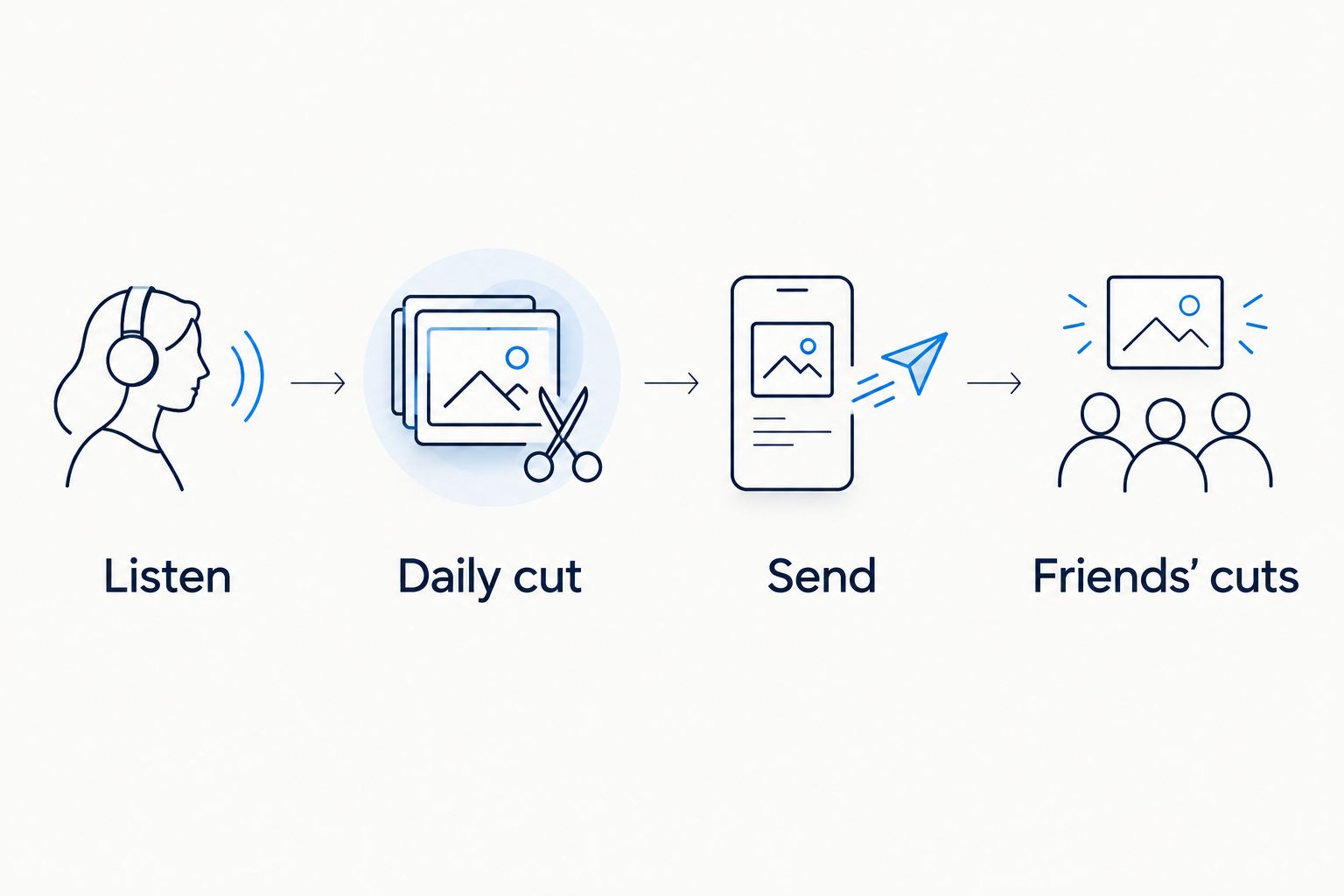
Daily cuts do not become weekly rankings simply because you read them all week. They show the shared daily selections. Use a charting tool when you need frequency across the whole period.
Try daily music sharing
Daycut shares daily cuts across Apple Music, Yandex Music, and Spotify through Last.fm. iOS only.
How these apps were ranked
The order follows the query, not a claim that one app wins every kind of music sharing. Weekly rankings come first. Daily cross-service sharing, social recaps, shared playlists, and same-service profiles each get a separate use case.
For this 2026 guide, the named sources have distinct scopes:
- Last.fm Help and profile chart controls: scrobbling, recorded listening, and chart periods.
- The daily-cut product site: supported services, iOS access, cut size, setup guidance, and the send-to-open rule.
- Airbuds' official app listing: friend listening activity, reactions, and weekly recaps.
- Spotify Support's Blend documentation: shared taste playlists and daily updates.
- Apple's Music User Guide: friend profiles, listening visibility, and shared playlists.
These sources describe mechanics. They do not establish a universal winner for every friend group. The ranking gives priority to the feature each option actually supplies.
Which app should you choose in 2026?
Choose Last.fm if you are undecided and weekly top songs are the requirement. It matches the question directly: recorded tracks, ranked over a selected period.
Choose the daily-cut app if the real problem is friends split across streaming services. Choose Airbuds if your group wants social activity with weekly recaps. Keep Spotify Blend for a shared playlist, or Apple Music profiles for following an Apple Music group.
Do not add an app merely to collect another feed. Pick the view your group will actually use, and accept its limits.
FAQ
What's the best app to see friends' top songs of the week?
Last.fm is the best fit for weekly track rankings based on recorded listening. Open a friend's visible profile and select the last 7 days; missing scrobbles leave gaps in the chart.
Does Daycut show a friend's weekly top songs?
No. Daycut shares a daily cut of up to 10 tracks, not a ranked weekly chart. It suits friends who want daily music sharing across different services.
Is Airbuds better than Last.fm for weekly listening?
Airbuds is better suited to social weekly recaps; Last.fm is better suited to inspecting track charts. Choose the recap format for a social summary and the chart format for recorded play rankings.
Can Spotify and Apple Music friends share listening in one app?
Yes. The daily-cut app connects Apple Music directly, while Spotify listeners connect through a Last.fm account. The app is available on iOS.
Does Spotify Blend show each friend's most-played songs this week?
No. Spotify Blend combines participants' listening tastes into a shared playlist that updates daily. Its track order is not an individual weekly play-count ranking.
Can I see friends' listening without leaving Apple Music?
Yes. Apple Music profiles let you follow friends and see shared listening and playlists, subject to visibility settings. That view is not a cross-service weekly chart.
Why is a friend's weekly listening chart incomplete?
Unrecorded plays do not enter a Last.fm chart. Check whether scrobbling worked during the selected period before treating the ranking as a complete account of the friend's listening.
One last thing
Your friend's favorite song and their most-played song are not necessarily the same. A weekly chart reports recorded behavior. A song someone deliberately recommends answers a different question.
For your 2026 setup, name the view honestly: weekly chart, daily cut, recap, or shared playlist. That small distinction makes the comparison useful.