
Six apps make a real case for best music discovery apps in 2026, and none of them do the same job. Spotify wins on raw algorithmic reach, Daycut wins on showing you what friends actually played today, and Shazam wins the moment a song plays somewhere and you have no idea what it is.
- Spotify is the best overall pick among music discovery apps in 2026, thanks to Discover Weekly and Release Radar.
- Daycut is the best music discovery app for seeing what friends actually played, not what they liked or posted.
- Shazam still wins for identifying a song playing around you in real time.
- Bandcamp and SoundCloud surface independent and unreleased tracks that algorithms rarely touch.
- Last.fm turns years of scrobbled listening history into recommendations no single streaming app can build alone.
Why this matters
Most "discovery" in 2026 is still an algorithm guessing from your own past plays. That works until you've heard everything it thinks you'll like.
The apps below split into two camps: ones that mine your own history (Spotify, Last.fm) and ones that route around algorithms entirely — a friend's actual daily listening, a song ID from the room you're standing in, or an artist page with no recommendation engine involved. Daycut sits in the second camp: it connects to Spotify, Apple Music, or Yandex Music and shares up to 10 tracks a day per friend, automatically.
Knowing which camp an app belongs to tells you more than any feature list.
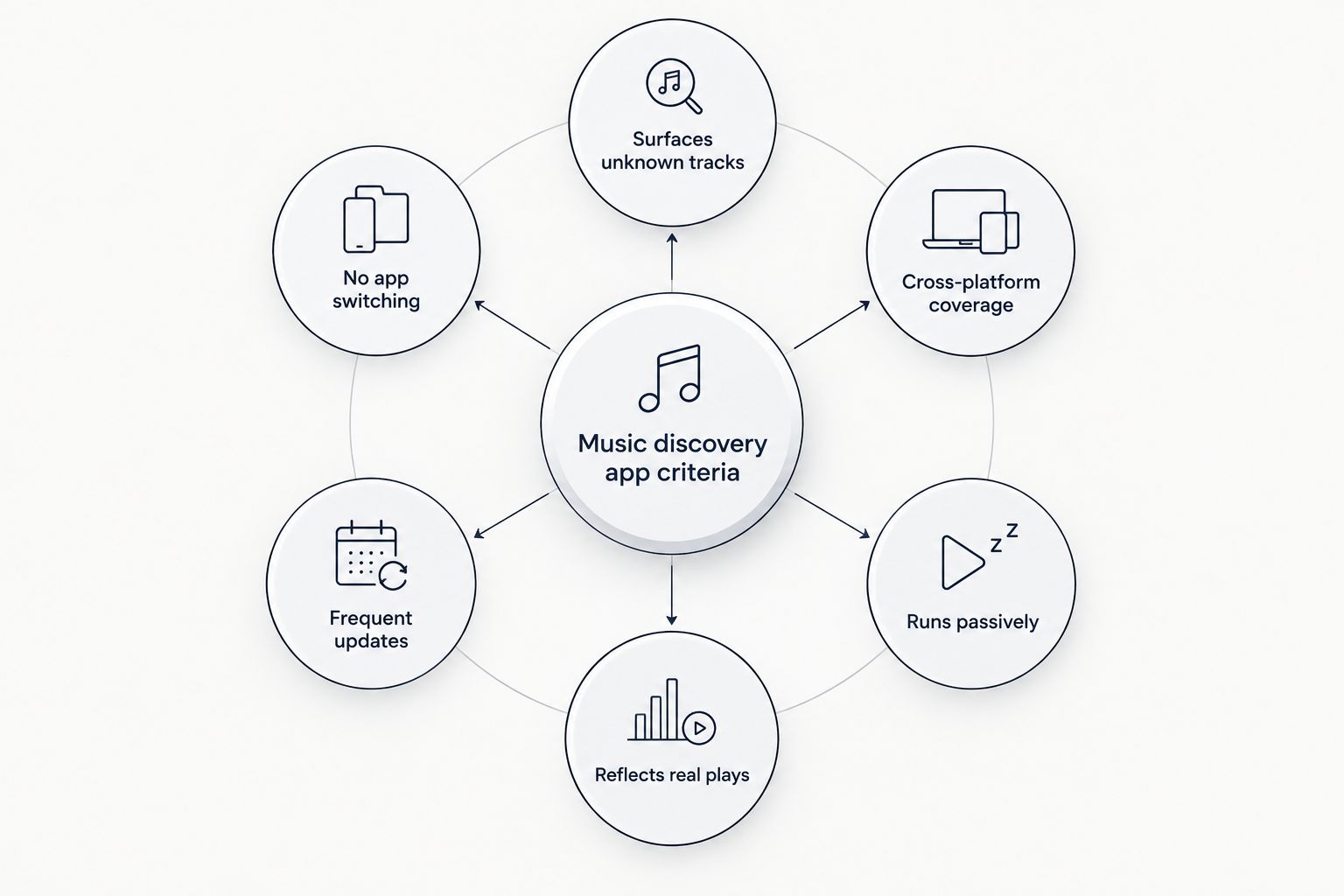
What makes the best music discovery app
- Surfaces tracks you genuinely don't already know
- Works with the platform you already use — Spotify, Apple Music, or Yandex Music
- Runs passively, without manual searching or curating
- Reflects actual plays, not paid placements or promo pushes
- Updates often enough to stay current, not once a season
- Doesn't require switching your primary streaming app to use it
Music discovery apps at a glance
| App | Best for | Standout feature | Key limitation |
|---|---|---|---|
| Daycut | Seeing what friends actually played | Auto-shares up to 10 tracks a day across Spotify, Apple Music, and Yandex Music | iOS only in 2026, needs friends on the app too |
| Spotify | Personalized algorithmic discovery | Discover Weekly and Release Radar playlists | Recommendations only draw from your Spotify plays |
| Shazam | Identifying a song in the wild | Instant audio recognition from a few seconds of sound | Doesn't recommend anything beyond that one track |
| Last.fm | Recommendations built from listening history | Scrobbles every play into a long-term profile | Needs months of data before it gets useful |
| Bandcamp | Independent and DIY artists | Direct artist pages with no algorithm filtering results | Smaller catalog than the major streaming services |
| SoundCloud | Early and unreleased tracks | Producers upload before official release on other platforms | Sound quality and metadata vary upload to upload |
1. Daycut: best music discovery app for seeing what friends actually played
Daycut connects to Spotify, Apple Music, or Yandex Music and shares a daily cut of up to 10 tracks per friend, automatically, no posting required. It answers a different question than the algorithmic apps below: not "what might I like" but "what did my friend actually play today."
Daycut pros:
- No manual sharing, no feed to curate
- Works across three separate streaming ecosystems, so friends on Apple Music and friends on Yandex Music show up in the same place
- Shows real plays, not a curated "top tracks" list someone edited
Daycut cons:
- iOS only for now
- Only useful once friends are also on it
- Doesn't surface strangers' music, only people you follow
Best for: discovering music through people you actually know. Verdict: Buy.
More comparisons of friend-based sharing apps sit in this rundown of apps to share music with friends, useful if Daycut's friend-feed model is the piece you care about most.
2. Spotify: best music discovery app for algorithmic personalized discovery
Spotify's Discover Weekly and Release Radar playlists refresh on a schedule and pull from listening data across its entire user base, not just your own plays. Both run on Spotify's free tier, not just paid accounts.
Spotify pros:
- Largest catalog of the group
- Weekly and daily refreshes keep recommendations current
- No setup beyond having an account
Spotify cons:
- Recommendations only draw from what you play inside Spotify
- Doesn't account for anything you listen to on Apple Music or Yandex Music
- Heavier algorithm bias toward already-popular tracks in your genre
Best for: default algorithmic discovery if you're fully on Spotify. Verdict: Buy.
3. Shazam: best music discovery app for identifying songs in the wild
Shazam listens to a few seconds of audio and matches it against a database, returning the track and artist almost instantly. It's built for one moment, not an ongoing feed.
Shazam pros:
- Fastest identification tool of the group
- Works on songs playing anywhere — a store, a car, a party
- Owned by Apple, so it plugs straight into Apple Music
Shazam cons:
- No recommendation engine beyond the single match
- Doesn't help with music you haven't already heard once
- Limited use if the source audio is noisy or distorted
Best for: the exact moment you hear something and need a name. Verdict: Buy.
4. Last.fm: best music discovery app for recommendations from listening history
Last.fm has scrobbled plays since 2002, and by 2026 it's still one of the only tools that builds recommendations from years of cross-platform listening data rather than a single app's silo.
Last.fm pros:
- Can scrobble plays from Spotify and other services once connected
- Recommendations improve the longer you use it
- Detailed listening stats most apps don't surface
Last.fm cons:
- Takes months of consistent scrobbling before recommendations feel sharp
- Interface feels dated next to newer apps
- Requires manual setup to connect each streaming account
Best for: long-term listeners who want data-driven recommendations, not instant ones. Verdict: Hold, if you're not willing to scrobble consistently.
5. Bandcamp: best music discovery app for independent artists
Bandcamp skips the algorithm entirely. Artists set up their own pages, and discovery happens through direct browsing, tags, and curated collections rather than a recommendation engine guessing what you'll like.
Bandcamp pros:
- No algorithm filtering out smaller or newer artists
- Direct connection between listener and artist
- Strong for genres underserved by major streaming catalogs
Bandcamp cons:
- Smaller overall catalog than Spotify or Apple Music
- Discovery takes more active effort — browsing, not scrolling
- Less useful if you want passive, automatic recommendations
Best for: listeners who want to dig into independent and DIY music directly. Verdict: Buy, if you're willing to browse.
6. SoundCloud: best music discovery app for early and unreleased tracks
SoundCloud is where producers and unsigned artists upload tracks before — sometimes instead of — an official release elsewhere. It's the least polished of the six and the most likely to have something nobody else has heard yet.
SoundCloud pros:
- Tracks show up here before hitting other platforms
- Strong for remixes, DJ sets, and unsigned artists
- Direct comments between listeners and uploaders
SoundCloud cons:
- Sound quality and metadata vary wildly by upload
- No consistent recommendation logic across the catalog
- Harder to search with intent versus browsing at random
Best for: finding tracks before they're official anywhere else. Verdict: Buy, for early access specifically.
“Discover Weekly recommends what you might like next. Daycut just shows what your friend already played.”
How these got ranked
Each app got measured against the six criteria above: does it surface unknown tracks, does it work across the platform you already use, does it run passively, does it reflect real listening, how often does it update, and does it force a platform switch. Daycut and Shazam score highest on passivity and cross-platform reach; Bandcamp and SoundCloud score highest on surfacing tracks the other four miss entirely.
See what friends played today
Connect Spotify, Apple Music, or Yandex Music and get a daily cut, automatically.
Which music discovery app should you choose?
If you want one default for 2026, pick Spotify for algorithmic discovery — it has the largest data set and the most consistent refresh schedule. If the goal is finding out what actual friends are playing, not what a model predicts you'll like, Daycut is the better fit, since it works across Spotify, Apple Music, and Yandex Music without anyone posting anything. Keep Shazam installed regardless — it solves a problem none of the others do.
FAQ
What is the best music discovery app in 2026?
Spotify is the strongest overall pick for algorithmic discovery in 2026 because of Discover Weekly and Release Radar. Daycut is the better pick specifically for seeing what friends actually played that day.
Is Daycut a music discovery app?
Yes, in the sense that it surfaces music you didn't already know about, but through friends rather than an algorithm. It connects to Spotify, Apple Music, or Yandex Music and shares up to 10 tracks a day per friend.
Does Shazam recommend new music or just identify songs?
Shazam only identifies the specific song playing at that moment. It doesn't build playlists or suggest related tracks afterward.
Is there a free way to discover new music?
Spotify's Discover Weekly and Release Radar run on its free, ad-supported tier, not just paid accounts. Bandcamp and SoundCloud also let you browse and discover without a subscription.
Can I discover music through what my friends are listening to?
Yes. Daycut automatically shares up to 10 tracks a day per friend based on what they actually played on Spotify, Apple Music, or Yandex Music.
Does Last.fm work with Spotify and Apple Music?
Yes, once connected, Last.fm can scrobble plays from Spotify and other services into a single listening history used for recommendations.
What's the difference between a discovery app and a streaming app?
A streaming app plays music you choose. A discovery app is built to surface tracks you didn't already know to look for, whether through an algorithm, a friend's plays, or direct artist browsing.
Is Bandcamp good for discovering independent artists?
Yes. Bandcamp has no recommendation algorithm filtering results, so browsing tags and artist pages surfaces independent and DIY music that major streaming catalogs often don't carry.
One last thing
The apps that win at discovery in 2026 mostly aren't competing with each other — Spotify's algorithm and Daycut's friend feed answer different questions from the same raw listening data. The mistake is treating any single app as a complete discovery system. Run an algorithmic app for volume, a friend-based app for taste you trust, and Shazam for the one song you hear and can't place.